The Chinese action followed 'India's recent, illegal construction of defence facilities across the border into Chinese territory in the Galwan Valley region', a write-up in the state-run Global Times tabloid said, quoting unnamed military sources.
It is learnt that Defence Minister Rajnath Singh has conveyed to top military brass that there was no need for reviewing the implementation of any of the key projects along the Line of Actual Control (LAC) in Ladakh, Sikkim, Uttarakhand or in Arunachal Pradesh in view of the aggressive behaviour by Chinese troops in several sensitive areas.
People familiar with the situation in the region said the two sides were engaged in trying to resolve the dispute, but there was no indication of a positive outcome yet as both the armies continued to bolster their positions in disputed areas of Pangong Tso and Galwan Valley and Demchok.
"There have been no intrusions or major face-offs in the area of responsibility of Eastern Command since the friction erupted in Ladakh," he said.
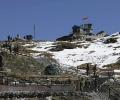
The government on Friday expressed deep concern over China constructing a road in the disputed Doklam area near Sikkim

An MoU on sharing hydrological information of the Brahmaputra River by China to India and another pact on amendment of the protocol on phytosanitary requirements for exporting rice from India to China to include non-Basmati rice were signed after the Modi-Xi talks in the eastern Chinese port city.

'The government will ensure that India's pride is not affected as far as the situation along Indo-China border is concerned'

The deliberations focused on bringing down tension along the disputed borders and ways to bridge the trust deficit.
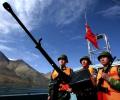
The Chinese side has particularly bolstered its presence in the Galwan Valley, erecting around 100 tents in the last two weeks and bringing in heavy equipment for construction of bunkers, notwithstanding the stiff protest by Indian troops. There have been reports of multiple incidents of transgressions by Chinese troops in several areas in Eastern Ladakh.
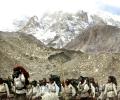
The Indian Army will continue to maintain its aggressive posturing in all disputed areas in eastern Ladakh and will not back off till status quo is maintained, sources said.

'These tactics are particularly evident in China's pursuit of its territorial and maritime claims in the South and East China Seas as well as along its border with India and Bhutan'

'When armies start attacking with clubs and batons, then at some point this can take an escalatory spiral and spin out of control.'

Outgoing Indian envoy to China Vikram Misri on Monday had a virtual farewell call on Chinese Foreign Minister Wang Yi during which he said that "certain challenges" had overpowered the vast opportunities in the bilateral ties last year and hoped that with continued communication the two sides would be able to resolve the current difficulties.

Giving an account of India's overall military modernisation, Lt Gen Pande also said that an in-principle approval has been given to new combat formations called the Integrated Battle Groups (IBGs) which can mobilise fast with a more effective approach.

The MEA said it was the Chinese side that recently undertakook activities hindering India's normal patrols in the areas.
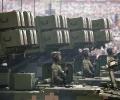
China hiked its annual defence budget by 7.1 per cent.
The comments came in the backdrop of the continuing standoff between the militaries of India and China at the LAC.

Sources said the incident took place around July 25.

India has over 4,000 medium tanks, but not a single light tank. It remains to be seen whether the Ladakh face-off with China galvanises a change, observes Ajai Shukla.

Defence Minister Rajnath Singh on Saturday asserted that the government will not allow India's pride to be hurt under any circumstances even as he said bilateral talks were on at military and diplomatic levels to resolve the row.
The MEA spokesperson did not reply to questions like whether the US had approached India with the offer, whether New Delhi has communicated its response over it to Washington, DC or whether the Trump administration has been briefed about the current standoff between Chinese and Indian soldiers in eastern Ladakh.

'The Chinese forces in the narrow Chumbi Valley are currently in the line of sight and fire of Indian forces poised on the ridges along the Sikkim-Tibet border.' 'Aware of this vulnerability, the Chinese have been eyeing the Doklam plateau,' explains national security expert Nitin A Gokhale.
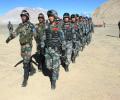
The talks between the two armies are going to be held this week at multiple locations including Patroling point 14 (Galwan area), Patrolling point 15, and Hot Springs area, top government sources said.
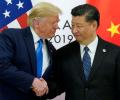
"We are capable of properly resolving the issues between us through dialogue and consultation. We do not need the intervention of the third party", he said.
The enhancement of combat capability by the two armies in the region came even as both the countries continued their efforts to resolve the dispute through talks at military and diplomatic levels.

The talks came a day after the two armies began a limited disengagement in a few areas in Galwan Valley and Hot Spring in a demonstration of their intent to end the row peacefully.
The Indian delegation led by Lt General Harinder Singh, the general officer commanding of Leh-based 14 Corps, and Commander of the Tibet Military District Maj Gen Liu Lin held an extensive meeting in Maldo on the Chinese side of the Line of Actual Control in eastern Ladakh on Saturday that began at around 11.30 am and went on till evening.
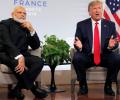
Trump on Wednesday said in a tweet that he was "ready, willing and able to mediate" between the two countries.
'Modi and Xi can solve the India-China border problem in a single sitting by keeping the big picture before them, by sweeping away the cobwebs of the past, and by mustering a statesman-like spirit and a long range vision,' says B S Raghavan, the distinguished civil servant.
The military brass is learnt to have apprised Modi about the evolving situation in eastern Ladakh, though officials maintained that the agenda of the pre-scheduled meeting was to discuss the ambitious military reforms and ways to boost India's combat prowess.

Congress as the opposition party has become increasingly aggressive against the Narendra Modi government over its handling of the border standoff with China.
'Even though an India-China military conflict scenario seems unlikely, its possibility gets enhanced if our capabilities are seen to be inadequate by the adversary,' warns Vice Admiral Premvir Das (retd).
'China's action towards India really gives you a good insight into how the Communist Party of China is thinking these days'
The article in the Global Times said that if India "stirs up conflicts in several spots, it must face the consequence of an all-out confrontation with China along the entire LAC."

Congress spokesperson Manish Tewari said Saturday's incident along the LoC was an outcome of Prime Minister Narendra Modi's "flip-flops and somersaults" on Pakistan.

By jettisoning the vision of multilateral world in favour of a Han Empire, China has posed a major long term challenge to India. India must stand firm against Chinese expansionism but also keep a door open for future detente by making a clear distinction between Chinese people and the current Chinese leadership, observe Lieutenant General Ashok Joshi (Retd) and Colonel Anil Athale (Retd).

The Indian defence ministry said its border security personnel, as per standard protocol, immediately alerted their Chinese counterparts to locate the UAV and they later reverted with its location.

Official sources said Tuesday's incident at Pangong and ways to maintain peace and tranquility along the Sino-India border in Ladakh were discussed at length at the border personnel meeting.
It also took exception to Australian Foreign Minister Julie Bishop's call for resolving the Doklam issue peacefully

Samdong Rimpoche's visit to China materialised against the backdrop of strained India-China relations consequent to the face-off between Indian and Chinese troops at Doklam, says former RAW officer Jayadeva Ranade.
 © 2026 Rediff.com - Advertise with us - Disclaimer - Privacy Policy - Sitemap - Feedback - About us - Terms of use - Grievances